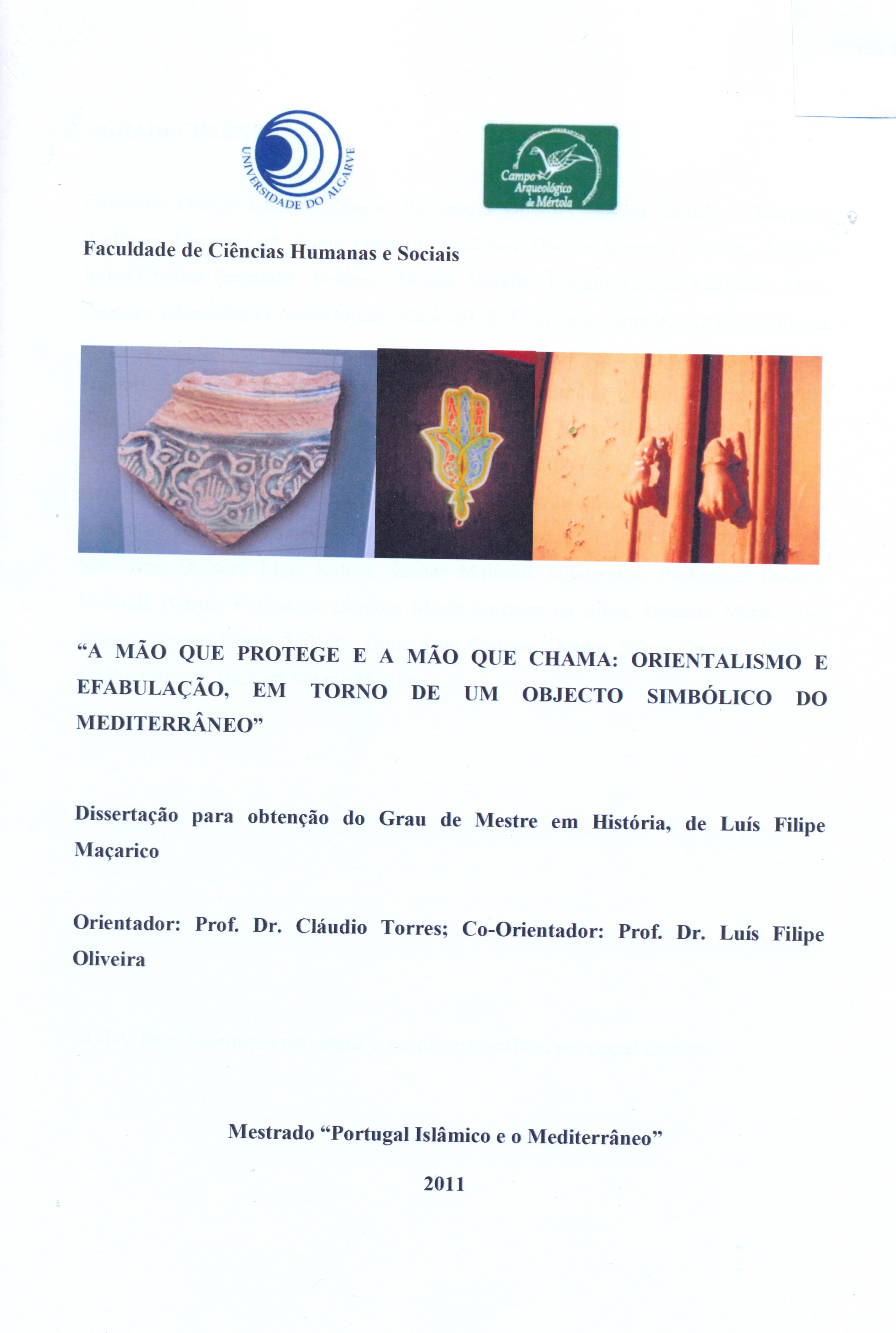
MAÇARICO, Luís Filipe - A mão que protege e a mão que chama: orientalismo e efabulação em torno de um objecto simbólico do mediterrâneo. Supervised by Cláudio Torres and Luís Filipe Oliveira. Faro: [s. n.], 2011. 142, [23] p. Master’s dissertation on Islamic Portugal and the Mediterranean, History section, presented to the Faculty of Human and Social Sciences of the University of the Algarve and to Mértola’s Archaeological Field.
The hand, as a symbolic representation of human activity, has accompanied communities of individuals since prehistoric times. Associated with the iconography of the goddess Tanit, this hand that spreads throughout the Mediterranean Basin integrates several cultural systems, from the Romans to Islamic civilisation, and to the present day, through the daily use in the Maghreb, corresponding to various interpretations that set it both in the context of superstition against the evil eye, and of presence (bilad) and hospitality. The reading of texts of an orientalist and fabled nature, namely by Leite de Vasconcelos, Adalberto Alves, and Pavón Maldonado, among others, led to this attempt of an analysis, to understand what is truth and what is fiction. Once the myth is installed, and despite some reliable testimony, it is not easy to dismantle a strategy that aims at the "exotic" and therefore at the "souvenir" for tourist consumption. This dissertation attempts to answer the following questions: Why does the open hand is referred to by some authors as the "Hand of Fatima"? And what is the reason for the closed hand in door stops to also be associated with the so-called "Hand of Fatima"? After all, what is tradition and what is invention?